Token tracker
Running
Runs on Brain →Records every AI model call made on my behalf, across Claude, Antigravity and the models on my Mac, in one ledger, and shows me where the usage goes.
- 25,900+model calls logged
- 4engines tracked
- 445automated tests
- 11system-check rules
HOW IT WORKS
Architecture
Code collects every call from every engine, attributes it to a project, and turns patterns into proposals I approve or deny.
Interactive diagram. Select a card to highlight what it feeds and what feeds it; press Escape to clear.
DASHBOARD
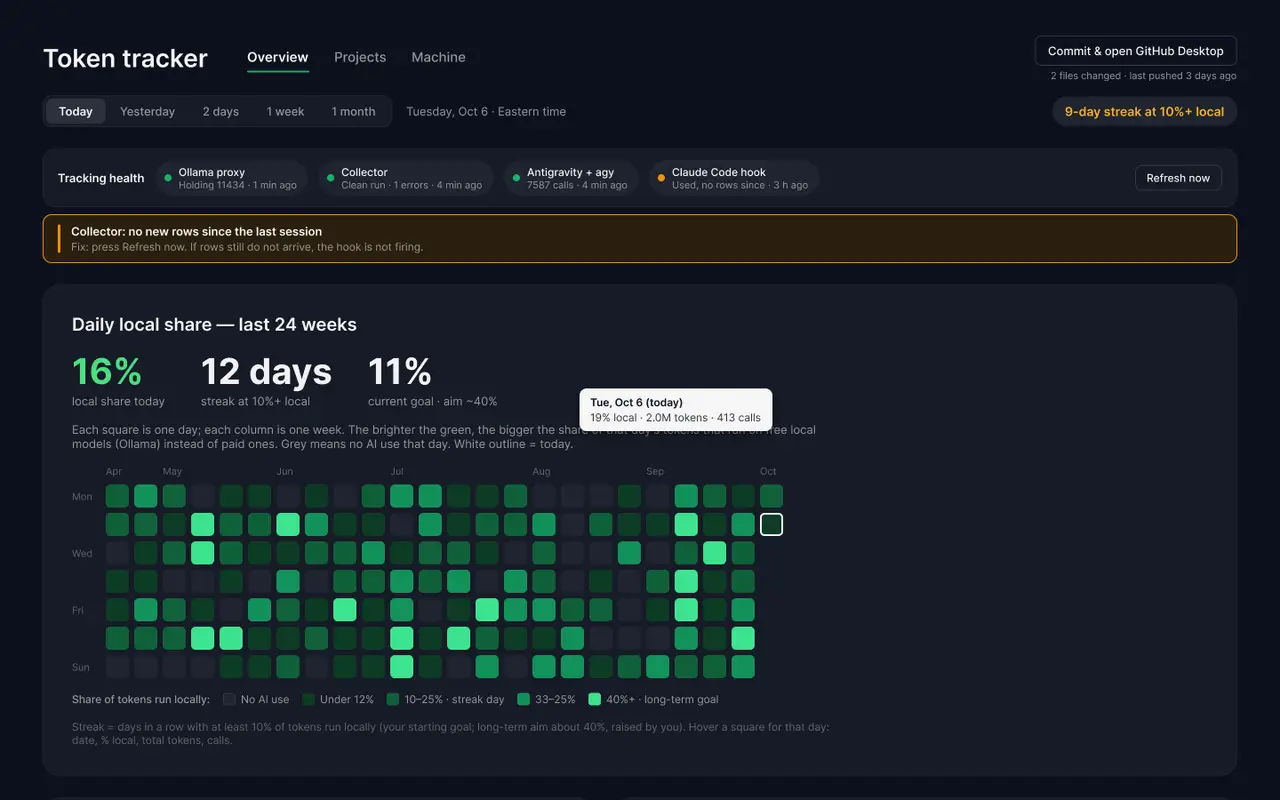
The dashboard
Shown with demo data. The real one runs privately on my Mac.
UNDER THE HOOD
What it actually does
Exact, from every engine
Each engine is read from its own per-call receipt. The one estimate is labelled and never added to exact totals.
A call, not a message
One message can trigger several calls, including silent retries. The ledger shows every one.
A drift guard on the format
If a vendor changes how it records usage, those rows are flagged and left out rather than guessed.
No double counting
One tool writes the same usage on several lines, so rows are matched on request ID before they count.
Compute, not only tokens
During each local call the proxy samples CPU, memory and swap once a second.
Attribution is an algorithm
The project with the most touched files wins, a tracker edit counts double, and ties are marked mixed.
No prompt text kept
The ledger stores no prompt text beyond a short, redacted opening line.
Locked to my Mac
The proxy and the dashboard refuse anything that does not come from the machine itself.
Secrets cannot be committed
A pre-commit scan blocks any key-shaped string, naming the file and line without printing the secret.
Two vendors review every proposal
Claude and Antigravity judge each proposal side by side. Automatic mode stays off unless every check agrees.
A denial sticks
A denied proposal does not come back when the same finding fires again, only when something genuinely new appears.
Tracking sits outside the model
A hook records usage after each reply, so no model is trusted to report on itself.
HOW I DESIGNED IT TO WORK
Exact, or labelled
Three lines from the spec I wrote for the tracker.
“Every engine is exact, read from its own per-call usage receipt.”
On accuracy
“Running Ollama must never skip the ledger.”
On local models
“Estimated figures … are always labelled and never summed into exact totals.”
On honest numbers
WHAT'S NEXT
Next, in order
Make the health check catch a run that hangs, not only one that fails.
Rule on the pending efficiency changes, such as worker limits for the job search.
Close the remaining gaps where some local calls pass through unrecorded.